The Outbound Search lists the Microsoft Teams calls that a user, number, or resource account placed during a chosen time period. For each call you can see who was called, when, how long it lasted, whether it was answered, and what type of call it was. It is the report to reach for when you want to focus on the calls going out from a single person or number.
Who Can Use This Report
What you can search depends on your role:
Role | What they can search |
Administrator / Global Manager | Any user, number, or pattern. A Search Criteria dropdown (Contains, Begins With, Ends With, Is Exactly) controls how the entry is matched. |
Manager | A drop-down list of the team members assigned to them, plus their own number. |
Standard user | Their own number only – pre-selected and locked. |
Performing an Outbound Search
- Click Microsoft Teams Calls on the menu bar.
- Select the Outbound heading to expand that section.
- Choose who to search for, and set any display options or filters you would like.
- Select the time period for the search.
- Press the Search button.
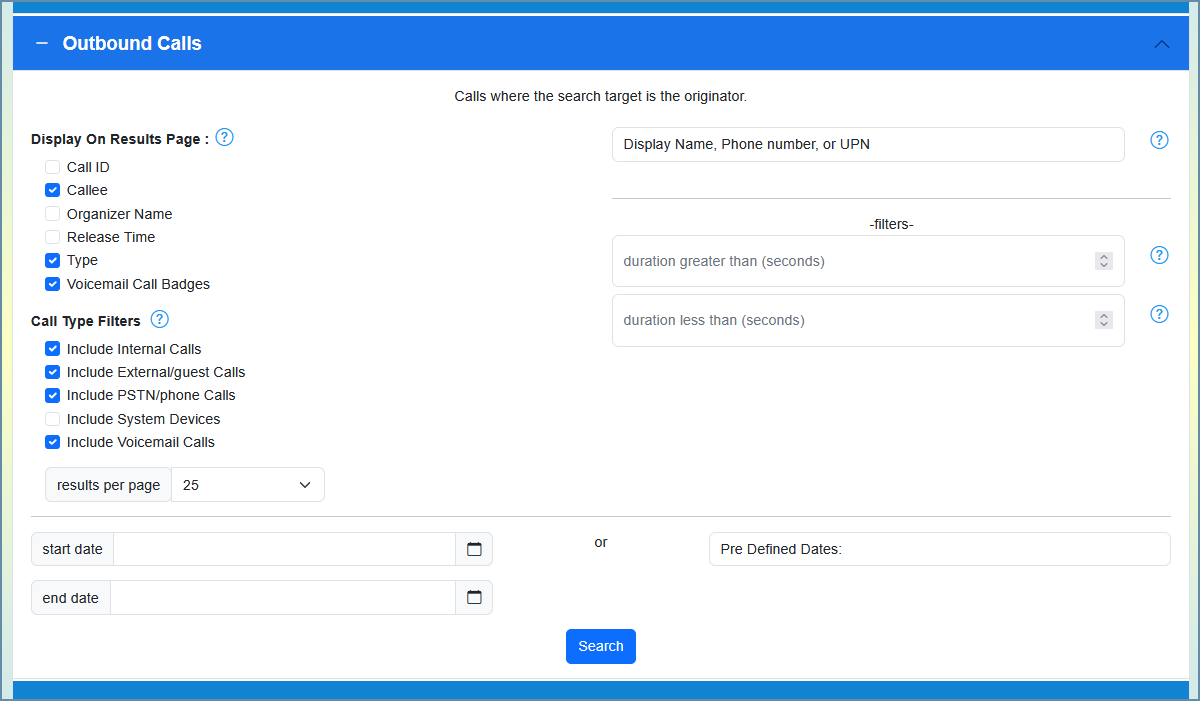
The Search Form
Who to Search For
Administrators and Global Managers type a number or name into the search box and choose how it should be matched with the Search Criteria dropdown:
Search Criteria | Behavior |
Contains | Matches any number or name that includes the text anywhere. |
Begins With | Matches entries that start with the text. |
Ends With | Matches entries that end with the text. |
Is Exactly (default) | Matches only the exact value entered. |
Managers select a team member from a drop-down list; standard users see only their own number.
Display On Results Page
These checkboxes add or remove columns and badges. They change how the report looks – they do not filter the data. The searched member is always shown as the caller, so there is no separate caller toggle.
Option | Description | Default |
Call ID | Show the unique Microsoft Teams call identifier (useful for cross-referencing with Microsoft). | Off |
Callee | Show the party that was called. | On |
Organizer Name | For group calls and meetings, show the name of the organizer. | Off |
Release Time | Show the time the call ended (disconnected). | Off |
Type | Show the call type – for example peer-to-peer or group call. | On |
Voicemail Indicator | Show a badge on calls that reached voicemail. | On |
Call Type Filters
These checkboxes decide which kinds of Teams calls are included in the results:
Filter | Description | Default |
Internal calls | Calls to another user inside your organization (Teams-to-Teams). | On |
External calls | Federated calls to Teams users in other organizations. | On |
PSTN calls | Calls placed to the public telephone network through Teams Phone. | On |
System devices | Calls involving non-user accounts such as auto attendants and call queues. | Off |
Voicemail calls | Calls that reached voicemail. | On |
Duration Filters
Two optional fields restrict results by call length: Duration Greater Than and Duration Less Than, both entered in seconds. For example, set Duration Greater Than to 60 to show only calls that lasted at least a minute. Leave them blank to include calls of any length.
Results Per Page
A drop-down sets how many calls appear on each page: 25, 50, 100, 250, or 500.
Date Range
Custom dates: Click the calendar icon to choose a start and end date and time. If left blank, the search defaults to today.
Predefined dates: Choose a preset range such as Today, Yesterday, or Last 7 Days.
Free License Limit: On a free license, the start date is capped at 7 days in the past. Older dates are automatically adjusted forward.
Once your time frame is set, click Search.
Understanding the Results
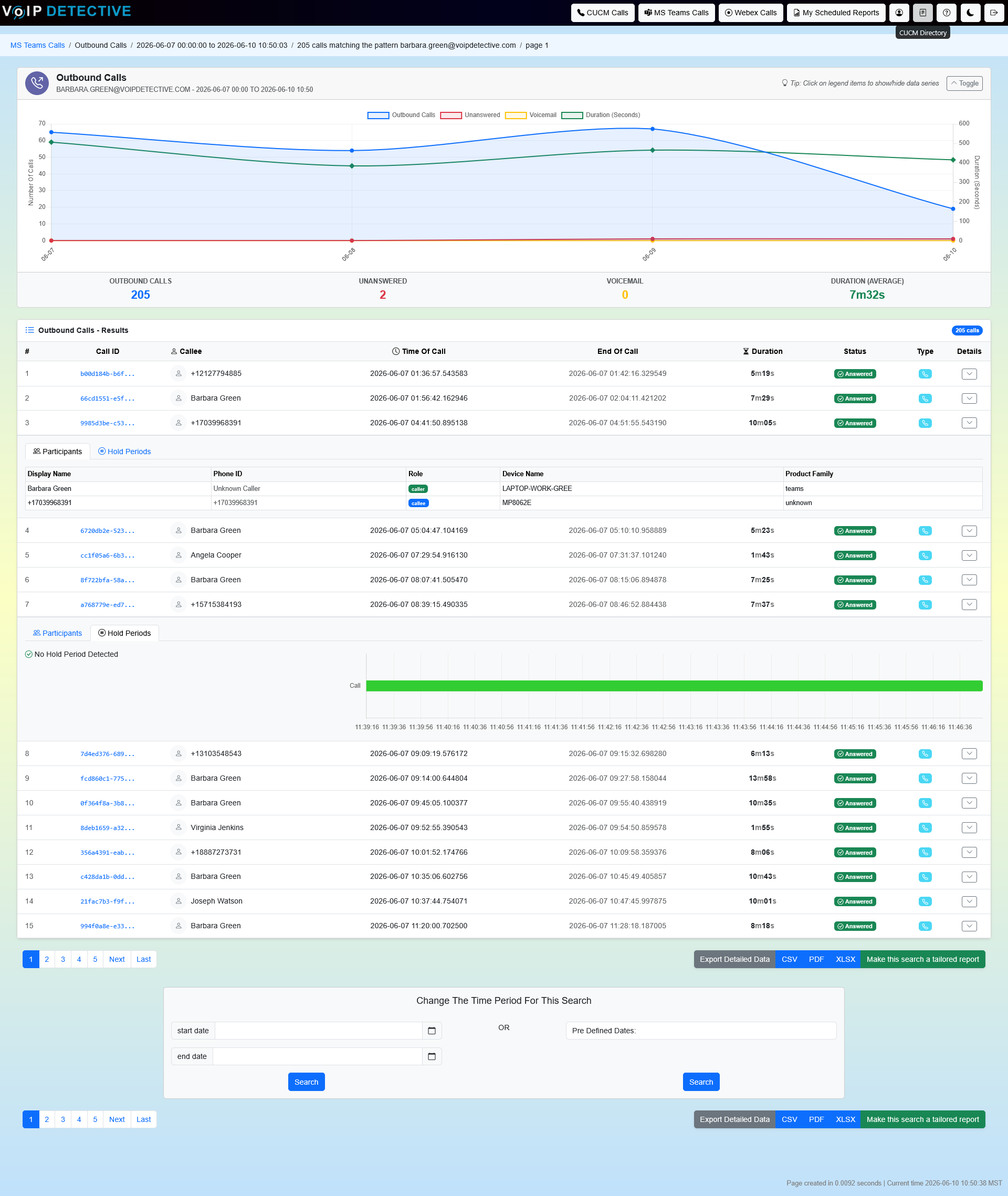
Outbound Calls Chart
A collapsible chart at the top plots outbound activity over time. It shows the total number of outbound calls, with separate lines highlighting unanswered and voicemail calls, and the total outbound count alongside. It gives you a quick read on calling volume and how many calls went unanswered before you scroll the table.
Results Table
The following columns can appear, depending on the display options you selected:
Column | Description |
# | A sequential row number. |
Call ID | The Microsoft Teams call identifier. Shown only if enabled. |
Organizer Name | The organizer of a group call or meeting. Shown only if enabled. |
Caller | The team member that placed the call. |
Callee | The party that was called. Shown by default. |
Time of Call | When the call started, in your configured time zone. |
Release Time | When the call ended. Shown only if enabled. |
Duration | How long the call lasted. |
Type | The call type, such as peer-to-peer or group call. Shown only if enabled. |
Status | An Answered or Unanswered badge for each call. |
Call Status and Highlighting
Outbound results use color so problem calls stand out at a glance:
Appearance | Meaning |
Green “Answered” badge | The call was answered. |
Red row + “Unanswered” badge | The call was not answered. |
Amber row | The call may have had poor audio quality. These are highlighted automatically so you can spot calls worth investigating. |
Call Indicators
Small badges beside a call mark its nature at a glance – External (a federated party in another organization), PSTN (a call over the public phone network), and Voicemail (a call that reached voicemail). You control which badges appear from the display options.
Pagination
Results are split across pages based on your Results Per Page setting, with navigation links above and below the table.
Exporting Results
Export buttons appear with the results. The export contains the same columns you chose to display on screen.
Format | Best For | Row Limit |
Printing and sharing. | 500 rows | |
XLSX | Analysis in Excel or Google Sheets. | 100,000 (PRO) / 1,000 (Free) |
CSV | Importing into other tools. | 100,000 (PRO) / 1,000 (Free) |
PRO: PRO users can schedule an Outbound Search to be generated and emailed automatically on a recurring basis.
Free and PRO Features
VoIP Detective Free includes | VoIP Detective PRO adds |
|
|
Was this article helpful?
That’s Great!
Thank you for your feedback
Sorry! We couldn't be helpful
Thank you for your feedback
Feedback sent
We appreciate your effort and will try to fix the article